




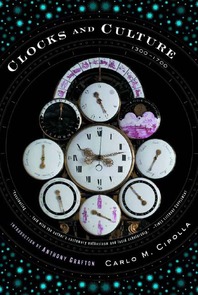
Clocks and Culture
1300-1700
2 September 2003
Territory Rights — Worldwide excluding Canada and the British Commonwealth.
Description
The history of the clock opens a window on how different cultures have viewed time and on Europe's path to industrialization.
How did a time-keeping device affect the growth of crafts guilds and the scientific research that led to the Industrial Revolution? Clocks and Culture is a brief history of the changes wrought by and on Europe over four hundred years due to technological advances in timekeeping and the rise of a time-aware culture. In his introduction, Anthony Grafton, Henry Putnam University Professor of History at Princeton University, puts this classic book in perspective.
Reviews
"Cipolla has a sharp eye for the heaven in a grain of sand. He takes a prosaic piece of hardware and uses it as a path into some of the central themes of history.... Imaginative and wide-ranging." — The Economist
"Brilliant.... Demonstrates the economic and technological development by which the continent thrust into the forefront of civilization." — The Listener
Also By: Carlo M. Cipolla 

Before the Industrial Revolution: European Society and Economy, 1000-1700
Third Edition, Paperback, 1994
The Third Edition includes substantial revisions and new material throughout the book that will secure its standing as the most useful history available of preindustrial Europe.
Between Two Cultures: An Introduction to Economic History
Paperback, 1992
“A scholarly, entertaining look at the objectives and techniques of economic historiography. . . . Cipolla’s presentation of economic history as a humanistic rather than scientific discipline makes...
Faith, Reason, and the Plague in Seventeenth Century Tuscany
Paperback, 1981
Recreates the struggles within plague-stricken Italy, relating events that led to a confrontation between the advocates of science and the followers of faith.