




Description
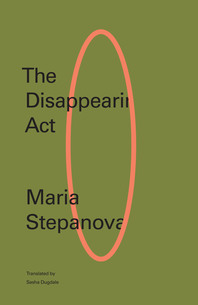
From the renowned Russian author of In Memory of Memory, a stunning new dreamlike work about exile and art
LONGLISTED FOR THE 2026 NATIONAL BOOK AWARD IN TRANSLATED LITERATURE
The writer M has lived in the city of B ever since her homeland declared war on a neighboring state. Exiled, she is unable to write there and suffers from loneliness, shame, and despair, but then M is invited to give a reading at a literary festival in a nearby country. After a series of missed connections and mishaps, including losing her phone, she finds herself all alone in the wrong coastal town, befriending a local man and attending the circus…
In this brief interlude, severed from reality, it seems as if M may finally escape from herself, from her past, from her nationality. She could start all over from scratch and join the circus. Written in Maria Stepanova’s rich and hypnotic prose, The Disappearing Act oscillates between reality and dream, between an oppressive present and a lost past, between life and literature.
Reviews
"Stepanova's prose work is discursive, expansively imaginative in its musings and digressions. The translation by Dugdale is lucid, vivid and fluid." — Barbara Conaty, Library Journal
"Captivating and capacious... The novel comes across as an urgent call to resist complacency and recover one's vitality in the face of injustice. It's a stunner." — Publishers Weekly (starred review)
"The Disappearing Act is a witty, unsettling and profound reflection on belonging and estrangement." — Abdulrazak Gurnah
"Poignant, ironizing its own ironies, as M finds two wrongs—any number of wrongs—never make a right."" — Michael Autrey, Booklist
"This is an intimate and profound study of liminality and identity from one of the most important writers of our time." — Pierce Alquist, Book Riot
"Dugdale’s translation is a loving one, beautifully rendering Stepanova’s melodic and rhythmic prose into precise English… With The Disappearing Act, Stepanova’s talents have grown to include a magical quality, and it leaves me longing for more of her tricks." — Olga Ziberbourg, On the Seawall
"Expect entrancing prose suffused with wry observations, a little humour and memories of lost worlds—the world lost with the fall of the Soviet Union; the world lost to Vladimir Putin; the world lost to the Ukraine war—more redolent of great poetry than contemporary fiction." — Marko Gluhaich, Frieze
"Existing somewhere between dream and reality, The Disappearing Act is a meditation on exile, identity, and the allure of disappearing completely from one of contemporary Russia's most critical voices." — Linnea Gradin, Electric Lit
"An essential book written with deep insight, despair and an intrinsic sense of the alarming recurrence of the present's failure to learn lessons from the past." — Catherine Taylor, The Irish Times
"The novel provides a striking articulation of the incongruity in M’s anonymity…M does not so much go off the grid as temporarily disappear into it—she finds herself in movement without the structure of departure and arrival." — Mathilde Hjertholm Nielsen, Kismet Magazine
"Beautifully suffocating…A gem of literature." — Madeline Schultz, Chicago Review of Books
"Russian poet Maria Stepanova anatomizes the moral attributes of language and identity in an elegiac novel mourning the disgrace of the ongoing Russo-Ukrainian war. . . Striking at the heart of a pressing crisis for a new wave of emigrants, The Disappearing Act is a concise investigation into the burden of national guilt and the hope for personal transformation." — Brock Covington, Open Letters Review
"This autofictional blend of memory and fable tracks a changing sense of self... echoes of poetry, skillfully conveyed by translator Sasha Dugdale." — Anna Aslanyan, The Guardian
"The Disappearing Act is about what happens when the story of one’s life cleaves in uncomfortable, incongruous ways… Stepanova’s short vignettes—that move elegantly between M’s external and internal worlds—keep the story skipping along." — Matthew Janney, Financial Times
"The success of The Disappearing Act lies in how diverting scenes inform larger questions about what makes us who we are when we’re without possessions and places and work, or how we categorize people in the absence of other identifiers, through nationality, for example... The greatest switchback is how it shows that if Stepanova, like her avatar M, is now a novelist in name only, she can nonetheless still do the job very well indeed." — John Self, The New York Times
"An intriguing short novel, written in lyrical, magnificently translated prose, about two days in the life of the novelist M who is journeying to appear at a literary festival. Losing herself, in a symbolic death and rebirth is where the story ends up, although we are left to doubt whether such an escape is really possible. . . M.’s story, a book for today, speaks eloquently to our own experience, as great literature is supposed to do. " — Kevin M. F. Platt, World Literature Today
"Exile is never solely a physical state of dislocation, but a linguistic and mental one too—all the more so when a language comes to feel implicated in violence. As Stepanova knows, dreams, like reality itself, can quickly become nightmares." — Luke Warde, The Irish Independent
"A fable of self-erasure, elegantly translated by Sasha Dugdale. The Disappearing Act is literature about a disavowal of literature: an illusion of a book that cannot be written." — Sam Sacks, Wall Street Journal
"Itinerant, whimsical, disturbing, brutal and, yes, beautiful." — Declan Fry, The Sydney Morning Herald
Also By: Maria Stepanova 

Holy Winter 20/21
Paperback, 2024
A deeply moving poem about winter and exile, war and the pandemic from “Russia’s greatest living poet” (Poetry) and the acclaimed author of In Memory of Memory
In Memory of Memory
Paperback, 2021
An exploration of life at the margins of history from one of Russia’s most exciting contemporary writers
Shortlisted for the 2021 International Booker Prize
Winner of the MLA Lois Roth Translation...In Memory of Memory
E Book, 2021
An exploration of life at the margins of history from one of Russia’s most exciting contemporary writers
Shortlisted for the 2021 International Booker Prize
Winner of the MLA Lois Roth Translation...
Holy Winter 20/21
E Book
A deeply moving poem about winter and exile, war and the pandemic from “Russia’s greatest living poet” (Poetry) and the acclaimed author of In Memory of Memory
Also By: Sasha Dugdale
Holy Winter 20/21
Paperback, 2024
A deeply moving poem about winter and exile, war and the pandemic from “Russia’s greatest living poet” (Poetry) and the acclaimed author of In Memory of MemoryIn Memory of Memory
Paperback, 2021
An exploration of life at the margins of history from one of Russia’s most exciting contemporary writers
Shortlisted for the 2021 International Booker Prize
Winner of the MLA Lois Roth Translation...In Memory of Memory
E Book, 2021
An exploration of life at the margins of history from one of Russia’s most exciting contemporary writers
Shortlisted for the 2021 International Booker Prize
Winner of the MLA Lois Roth Translation...Holy Winter 20/21
E Book
A deeply moving poem about winter and exile, war and the pandemic from “Russia’s greatest living poet” (Poetry) and the acclaimed author of In Memory of Memory
