




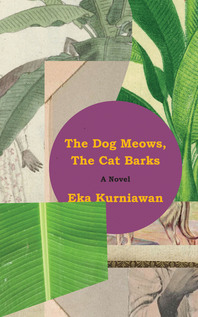
Description
A swift, intense novel about a teen rebelling against forced religious conformity in a small Javanese town, The Dog Meows, the Cat Barks ponders that perpetual human question, can we ever really be free?
Sato Reang enjoys an idyllic childhood of soccer, fighting crickets, and mischief in his Indonesian village—until the day he must be circumcised, and his observant father forces him into a life of Islamic piety. For years, Sato outwardly obeys his father, but all the while the boy chafes at the strictures of his religious routine, longing for everyday pleasures and vowing to himself that he will “become a child who was not pious.” His freewheeling linked anecdotes—mixing worldliness and naïveté, cruelty and innocence—are narrated with a toggling between first and third person (“I”/“he” or "Sato Reang") that potently conveys his disassociation. His adolescent, hormone-fueled crotchetiness expresses dissent: I stopped going to mosque. I no longer joined in worship. I never said my prayers before bed. Sato Reang eats with his left hand—so stupid—and barges in where he pleases, without calling out a greeting. If I was feeling lazy, I’d just piss on a banana tree, and I wouldn’t wash myself off after. But amid various mysterious portents and even within the hilarity, Sato’s callow sang froid (with its undercurrents of pain and shame)—and his comic pranks—soon invite tragedy.
A psychologically timeless story—anyone who’s ever had an overbearing parent and resented them will relate—The Dog Meows, the Cat Barks is Eka Kurniawan’s most contemporarily relevant book: he’s thinking about (and rejecting) militancy and moral certitude of any kind.
Reviews
"Brash, worldly and wickedly funny, Eka Kurniawan may be South-East Asia’s most ambitious writer in a generation." — The Economist
"Without a doubt the most original, imaginatively profound, and elegant writer of fiction in Indonesia today: its brightest and most unexpected meteorite. Pramoedya Ananta Toer has found a successor." — Benedict Anderson, New Left Review
"Very striking." — Tariq Ali
"An arresting portrait of Indonesia’s struggle for nationhood, delights in obscenity: no topic is spared from its bloodthirsty brand of satire." — Gillian Terzis, The New Yorker
"A howling masterpiece, a sheer burst of particular talent." — Chigozie Obioma, The Millions
"A pensive portrait of rural anomie. Kurniawan’s story seems sure to offend fundamentalist sensibilities, and has plenty of unsettling moments for the secular reader, too. A memorable look into a delinquent mind, one with little hope for any future other than hell." — Kirkus
"A deeply resonating examination of destructive familial bonds, the sincerity of religious piety, and the (not-so-)small rebellions the oppressed enact for sanity and survival." — Terry Hong, Booklist
"Kurniawan flips effortlessly from first to third person, creating a fun and textured style, which blends a clear-eyed perspective with moments of visceral emotion. This brims with humor and heart." — Publishers Weekly (starred)
"A portrait of childhood that is both funny and quietly devastating. The jokes are never just jokes. They carry within them the weight of expectation, fear, and control. Kurniawan’s prose, beautifully translated by Annie Tucker allows the reader to see the world stripped of its usual justifications. " — Vikram Zutshi, Asian Review of Books
"A compelling coming-of-age story that darts in and out of the first person, transmitting a memorable sense of alienation to the reader. Its protagonist’s realization of himself is not the only focus here; Kurniawan is also interested in the space where rebellion curdles into something much more unpleasant." — Tobias Carroll, Words Without Borders
"Translated with remarkable clarity by Annie Tucker, the short novel offers a strikingly intimate perspective on childhood—not as remembered by an adult, but as experienced by a child. With humour and pathos, Kurniawan renders an experiential portrait of childhood set in small-town Indonesia, while revealing its profoundly universal contours." — Bindu Menon, The Tribune
"A distillation of the themes that have preoccupied Kurniawan throughout his career... Sato's youthful restlessness turns out to harbor a class ressentiment after all." — Reuven Pinnata, LA Review of Books
"The Dog Meows is about the household rather than the nation; the political is paternal. Annie Tucker's translation of the novel is swift and commendable." — Vasudevan Mukunth, The Hindu
Also By: Eka Kurniawan 
Vengeance Is Mine, All Others Pay Cash
E Book, 2017
Vivid, bawdy, comic, and arresting, the exciting new novel by the Indonesian phenomenon, Eka Kurniawan
Vengeance Is Mine, All Others Pay Cash
Paperback, 2017
Vivid, bawdy, comic, and arresting, the exciting new novel by the Indonesian phenomenon, Eka Kurniawan
Beauty Is a Wound
Paperback, 2015
The English-language debut of Indonesia's rising star.
Beauty Is a Wound
E Book, 2015
The English-language debut of Indonesia's rising star.
Also By: Annie Tucker
Vengeance Is Mine, All Others Pay Cash
E Book, 2017
Vivid, bawdy, comic, and arresting, the exciting new novel by the Indonesian phenomenon, Eka KurniawanVengeance Is Mine, All Others Pay Cash
Paperback, 2017
Vivid, bawdy, comic, and arresting, the exciting new novel by the Indonesian phenomenon, Eka KurniawanBeauty Is a Wound
Paperback, 2015
The English-language debut of Indonesia's rising star.Beauty Is a Wound
E Book, 2015
The English-language debut of Indonesia's rising star.
