




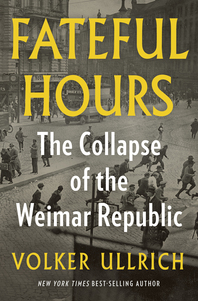
Fateful Hours
The Collapse of the Weimar Republic
21 November 2025
Territory Rights — Worldwide including Canada, Singapore and Malaysia, but excluding the British Commonwealth.
Description
From the New York Times best-selling historian, the riveting story of the Weimar Republic—a fledgling democracy beset by chaos and extremism—and its dissolution into the Third Reich.
Democracies are fragile. Freedoms that seem secure can be lost. Few historical events illustrate this as vividly as the failure of the Weimar Republic. Germany’s first democracy endured for fourteen tumultuous years and culminated with the horrific rise of the Third Reich. As one commentator wrote in July 1933: Hitler had “won the game with little effort. . . . All he had to do was huff and puff—and the edifice of German politics collapsed like a house of cards.” But this tragedy was not inevitable.
In Fateful Hours, award-winning historian Volker Ullrich chronicles the captivating story of the Republic, capturing a nation and its people teetering on the abyss. Born from the ashes of the First World War, the fledgling democracy was saddled with debt and political instability from its beginning. In its early years, a relentless chain of crises—hyperinflation, foreign invasion, and upheaval from the right and left—shook the republic, only letting up during a brief period of stability in the 1920s. Social and cultural norms were upended. Political murder was the order of the day. Yet despite all the challenges, the Weimar Republic was not destined for its ignoble end.
Drawing on letters, memoirs, newspaper articles, and other sources, Ullrich charts the many failed alternatives and missed opportunities that contributed to German democracy’s collapse. In an immersive style that takes us to the heart of political power, Ullrich argues that, right up until January 1933, history was open. There was no shortage of opportunities to stop the slide into fascism. Just as in the present, it is up to us whether democracy lives or dies.
Reviews
"In Fateful Hours, the road map to authoritarian disaster is laid out in gleamingly sinister detail by German historian Volker Ullrich. . . Ullrich breaks new ground, laying out his case in illuminating granularity, moving inch by inch through the political machinations that began with the establishment of Germany’s first democratically elected government, in 1919, and ended with the chancellorship of Hitler. . . The parallels to our own moment aren’t perfect, but they are resonant enough to make us ask, once again, who or what it will take for us to save ourselves." — Casey Schwartz, New York Times
"Immersive, masterful and profoundly disturbing…Outstanding…likely to be studied for decades or more as a standard work on the Weimar tragedy." — Andrew Lynch, Irish Independent
"In his hands, the death of the Weimar Republic is a parable of missed opportunities to save liberal democracy. . . An elegant and sober account. . . by a master storyteller." — Oliver Moody, The Times
"An engaging retelling of a momentous era of history…a close-up view of the flawed political mechanics of a time not entirely unlike our own." — Katja Hoyer, Spectator
"Uncomfortably timely…The parallels to our own time, as Ullrich lays them out in this fluent narrative, are alarming, with new authoritarian parties and governments following the fascist playbook in every detail, from culture wars and book banning to anti-immigration decrees and the steady, willful erosion of the constitution and democratic practices." — Kirkus Reviews
"A prescient reminder of the fragility of democracy. " — Booklist
"A resonant and sobering cautionary tale of how a democracy can die." — Publishers Weekly
Standalone Ebook
9781324110552

COMING SOON