




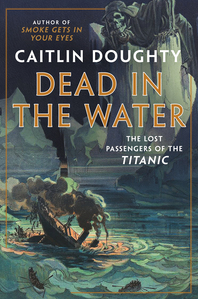
Dead in the Water
The Lost Passengers of the Titanic
6 April 2027
Territory Rights — Worldwide including Canada, Singapore and Malaysia, but excluding the British Commonwealth.
Description
New York Times best-selling author Caitlin Doughty presents Titanic like never before: through the stories of those who died—and what happened to the bodies.
Millions of people trust Caitlin Doughty to explore dark subjects with empathy and humor. Now, in her most ambitious work to date, Doughty explains what actually happened to the 1,500 people who died the night of history’s most famous shipwreck. Alongside white-knuckle tales of survival and mass death during the disaster, Doughty foregrounds the haunting stories of lesser-known victims, profiles the telegraph-cable-repairmen–turned–seafaring-undertakers who pulled the floating bodies from the wreck site in the North Atlantic, and explores how a salvage company came to control the human artifacts—shoes, hairbrushes—carried and worn by the dead passengers and crew. Along the way she shares the surprising science of death at sea, and how the Titanic tragedy led to mass casualty protocols still used today. The first book of its kind on one of the most famous events in human history, Dead in the Water explores how we face the void and accept (or refuse to accept) death in extreme conditions.
Reviews
"I know, I know. What new can possibly be written about the Titanic and its 1,500 victims? If best-selling storyteller Caitlin Doughty is doing the writing, quite a lot, it turns out, because she uses the famous wreck to study our fear of and fascination with death itself. She goes beyond the rescue to the recovery, explaining the myriad ways the passengers actually died at sea, how their personal effects ended up in the hands of a salvage company, and how the survivors came to terms with the tragic deaths of their loved ones—or didn’t. Trust me, you haven't read this one before, and you won't be able to put it down." — John U. Bacon, author of The Gales of November
"Caitlin Doughty has taken a subject as well known as any could be and somehow made it new. Dead in the Water tells the story of Titanic’s dead with compassion, scrupulous care, and an honorable dedication to understanding what it meant to die in the most famous shipwreck of all. . . . As a reader, you can’t help but be infected by her fascination, but also to learn its human lesson: that we are drawn to such stories of death as a way of reckoning with our own." — Sophie Elmhirst, author of A Marriage at Sea
"The immediacy and the drama of Caitlin Doughty's account brought me up short on the first page and never let up. Here are the people on the doomed ship as if we knew them. Here are the people who survived as if we were them. Doughty's prose is unstoppable and devastating. This book is a masterpiece of both scholarship and storytelling." — Sebastian Junger, author of The Perfect Storm, TribeIn My Time of Dying
"This is the Titanic book I have been longing for. It’s empathetic to its bones. While the Titanic mythos thrives on its mysticism and sensationalism, this is a stark, deeply human, chilling and curious meditation on the nature of death—both its inevitably and how resistant we are to face it in the western world. I expected to pick up a book about the Titanic, but what lurks within these pages is a reflective and strangely comforting examination of what waits for us at the end." — Lucy Rose, author of The Lamb
Also By: Caitlin Doughty 
Will My Cat Eat My Eyeballs?: And Other Questions About Dead Bodies
Paperback, 2020
New York Times bestseller
Winner of a Goodreads Choice Award
"Funny, dark, and at times stunningly existential." —Marianne Eloise, Guardian
Will My Cat Eat My Eyeballs?: Big Questions from Tiny Mortals About Death
Hardback, 2019
Best-selling author and licensed mortician Caitlin Doughty answers real questions from childrenabout death, dead bodies and decomposition.
Will My Cat Eat My Eyeballs?: And Other Questions About Dead Bodies
E Book, 2019
Best-selling author and licensed mortician Caitlin Doughty answers real questions from childrenabout death, dead bodies and decomposition.
From Here to Eternity: Traveling the World to Find the Good Death
Paperback, 2018
A New York Times and Los Angeles Times Bestseller
“Doughty chronicles [death] practices with tenderheartedness, a technician’s fascination, and an unsentimental respect for grief.” —Jill Lepore, ...
From Here to Eternity: Traveling the World to Find the Good Death
Hardback, 2017
A New York Times and Los Angeles Times Bestseller
The best-selling author of Smoke Gets in Your Eyes expands our sense of what it means to treat the dead with "dignity."
Ebook
9780393249941

Powered by VitalSource
£18.50
Coming Soon