




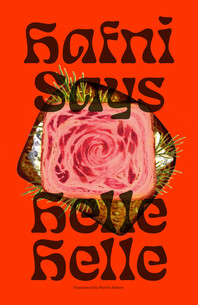
Description
A marvelously inventive road-trip novel, told as one long conversation in the aftermath of a capsized marriage
Hafni says: I don’t want to be me. I want to change who I am. I don’t know how to change who I am.
Hafni has come to the end of her marriage. From a rest stop she phones the novel’s narrator—a main character from Helle Helle’s previous novel they—but it’s she who does all the talking. She’s been celebrating impending divorce with a “smørrebrød tour” of the southern Danish countryside, where she samples Danish classics, chiefly open-faced sandwiches and afternoon tea. A trip that was meant to take a week digresses once, then twice, until it ends up taking Hafni an entire month. As told in tightly controlled, splintered mini chapters, the book incarnates how Hafni herself digresses, and dwells. She seems to view her past as one long series of accidents and mistakes, the accumulation of which somehow became the life she was living, a life that she now longs to cast off so she can start anew. Nominated for the Nordic Council Literature Prize, Hafni Says is brought into English in a magnificent translation by Martin Aitken.
Reviews
"Surprisingly devoid of ego, and deeply thoughtful." — The Paris Review
"Helle Helle surpasses herself in this tale of shame and screw-ups. Like few writers, she manages to reproduce herself in such a way that each new novel buds from the one(s) before it, not as a clone or a one-to-one copy, but as one of those small wonders that life bestows upon us. A kind of literary-evolutionary self-propagation, a self-refining process of cell division, the art of writing at its very best." — Berlingske
"One of my favorite Danish writers—she’s the master." — Olga Ravn, The Guardian
"Hafni Says is artfully constructed, the language is spare yet refined, full of half-sentences and gaps, with pauses for glances and gestures, for revelations, joys, and disappointments. This is poetry, compressed storytelling that builds, through a hundred small scenes, into a sweeping novel. Helle Helle crafts this female tragicomedy with unburdened elegance." — Neue Zürcher Zeitung
"Off-kilter domestic encounters characterize her disquieting fiction." — Thomas Meaney, Granta
"The delicacy of the comedy, the melodrama of Hafni’s aches and pains, the brief friendships and wild misunderstandings, the lasting mortification of a faux pas from back in the day—only the Danish novelist Helle Helle can make this human and not pathological...A striking tale in which capitalization seems too emphatic for precarious living and suffering in a minor, muted key." — Booklist
"Compact, witty and episodic—written in short sections that mix exquisite attention to detail with impressionistic interludes. You read Hafni Says like the smørrebrœd it describes: in small delectable portions, nodding along to its observational precision, chewing over its subtle, layered flavors, wistfully yearning for more when it's all over so suddenly." — Matthew Janney, Financial Times
"A simple story that contains a complex exploration of self-determination, loneliness, and ordinary luck...Over the course of Hafni’s meandering journey, the reader sees her experiment with different models of how to be—the woman who slips on pumps before she teeters into a hotel, the woman who lingers in a bare-bones hostel for the pleasure of her simple room, the woman pursued by “eternal embarrassment” for social gaffes committed in the distant past. All of these, and more, are Hafni. " — Kirkus Reviews
"Hafni Says is close to perfection...Conversational, acerbic, melancholy and so full of everyday truths and observations that it is difficult to resist the urge to underline every phrase." — Catherine Taylor, Irish Times
"In this wry, piquant book, a kind of road novel without epiphany or climactic resolution, what matters isn’t what happens as such but the ways in which sensitivity and self-consciousness can crowd and shape a person’s life." — The Saturday Paper
Also By: Helle Helle 

they
Paperback, 2026
From one of Scandinavia’s finest and best-loved novelists comes a startlingly intimate and powerful portrait about the fragile, yet irrevocable bond between a young girl and her dying mother
they
E Book
From one of Scandinavia’s finest and best-loved novelists comes a startlingly intimate and powerful portrait about the fragile, yet irrevocable bond between a young girl and her dying mother
Also By: Martin Aitken
Girl, 1983: A Novel
Paperback, 2026
“[Linn Ullmann has] achieved something rare.” —Nadja Spiegelman, New York Times Book Review
This stunning novel explores desire and anxiety, beauty and youth, memory and power.they
Paperback, 2026
From one of Scandinavia’s finest and best-loved novelists comes a startlingly intimate and powerful portrait about the fragile, yet irrevocable bond between a young girl and her dying mother
The Wax Child
Hardback, 2025
An astounding, haunting tale of accused witches—a book of sorcery itself—from the celebrated author of The Employees and My Work
Girl, 1983: A Novel
Hardback, 2025
This stunning novel explores desire and anxiety, beauty and youth, memory and power.
The Employees: A workplace novel of the 22nd century
Paperback, 2023
Shortlisted for the International Booker Prize and the Ursula K. Le Guin Prize,The Employeesreshuffles a sci-fi voyage into a riotously original existential nightmare
