




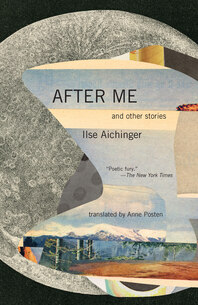
Description
The powerful and disturbing stories of legendary postwar Austrian-Jewish writer Ilse Aichinger
When someone pushes the bed out of the hall, when you see that the sky is turning green, and if you want to spare the vicar a funeral sermon, then it is time for you to get up, quietly, as children get up when the morning light starts to glint through the shutters, secretly, so the nurse doesn’t see—and quick!
Like the short fiction of Silvina Ocampo and Bruno Schulz, Aichinger’s chilling and surreal stories will haunt you long after reading. Her deft experiments with the language used and corrupted by the Nazis seem almost to bend time—reversing it and compressing it—so that possible future and past selves live among ghosts, the alienated, and the displaced. Like tricks of the eye, a crime seen from a distance, or an unlikely coincidence, Aichinger’s singular fiction—heavily influenced by cinema—questions the solidity of existence.
A member of the hugely influential Gruppe 47, which included Ingeborg Bachmann, Paul Celan, Uwe Johnson, and Günter Grass, Aichinger is one of the last of her peers to find world fame. Now available in Anne Posten’s deft translation, After Me collects the greatest of Aichinger’s short works.
Reviews
"Daring and masterful texts." — Words Without Borders
"Aichinger's language shows us how surprisingly, sensually, musically, and above all playfully a human brain can link together different thoughts and images. Since it is this ability that makes us human, it isn particularly important in the age of AI that we keep reading her." — Yoko Tawada
"Aichinger’s poetic fury and spirited tenderness is of the same tradition as Brecht." — Kay Boyle, New York Times
"Ilse Aichinger relies solely on her own deep—yes, one might even call it wild—nature. It is a very wild form of literature, almost a primal one." — Peter Handke, Nobel Laureate
"Ilse Aichinger, with whom the story of postwar Austrian literature begins, has been until recently overlooked and undertranslated. Her art begins with an address to skepticism—with a distrust of language, of collective self-righteousness, and, above all, of oneself." — Benjamin Balint, Liberties Journal
"At first glance Aichinger's stories seem simple, if strange enough to evoke Kafka. It is when the language of the stories cracks, seems slightly "off," that we glimpse they are written in a matrix of terror: of Nazi brutality that Aichinger experienced, of what it (and other forms of state or religious terror) did and do to people—and to language, as Anne Posten demonstrates in her sensitive translation." — Rosmarie Waldrop
Also By: Anne Posten 

Walks with Walser
Paperback, 2017
A unique and personal portrait of the beloved, legendary Swiss writer, finally in English
Walks with Walser
E Book, 2017
A unique and personal portrait of the beloved, legendary Swiss writer, finally in English
Also By: Yoko Tawada

The Bridegroom Was a Dog
Hardback, 2026
A bizarre tale of passion and romance between a schoolteacher and a dog, from the incomparable National Book Award-winning Yoko Tawada
Archipelago of the Sun
Paperback, 2025
In the concluding volume of her enormously popular, mind-expanding, and cheerfully dystopian trilogy, Yoko Tawada’s intrepid young band of friends strike out in search of the lost Land of Sushi
Suggested in the Stars
Paperback, 2024
On the heels ofScattered All Over the Earth, Yoko Tawada’s new and irresistibleSuggested in the Starscarries on her band of friends’ astonishing and intrepid adventures
Paul Celan and the Trans-Tibetan Angel
Paperback, 2024
A moving story about friendship, illness, and the poetry of Paul Celan by the astonishing Yoko Tawada, winner of the National Book Award
Three Streets
Hardback, 2022
Yoko Tawada—winner of the National Book Award—presents three terrific new ghost stories, each named after a street in Berlin