




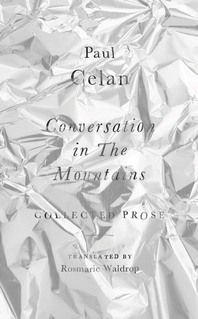
Description
The essential prose works of the great Paul Celan, beautifully translated by Rosmarie Waldrop
Reviews
"For Celan, whose poems moved ever closer to silence, prose was too noisy a medium. It is indeed fortunate that various occasions prodded him to write these texts. They are invaluable for defining the place from which Celan writes." — Rosmarie Waldrop, from the Introduction
"Celan’s work is jolting by design, often seeming to herald from an alien universe… He delivers cloudy pronouncements in the cryptic yet authoritative tones of a prophet." — Becca Rothfeld, The Poetry Foundation
"Celan stands within the tradition of Hölderlin and Rilke. Despite the difficulties his work offers the reader, he is a public poet, a writer concerned with the great events of the time. He stands in the same relation to the world of the massacres as does the author of Lear to the cruelty, poverty, and madness of his time." — J.M. Cameron, The New York Review of Books
"These writings provide an exquisite insight into Celan's poetry, and into the form, then and today... For Celan, strangeness, or estrangedness is an instance of truth—the strange, the wonderful, and the true are collapsed." — Theodore Anderson, Newcity Lit
"This recent arrival provides enormous insight into how Celan's many personal devils meshed to create one of the great bodies of work in 20th-century poetry. Rosmarie Waldrop's translation casts complementary light on Celan." — Mitchell Abidor, Los Angeles Review of Books
"The most consequential postwar German-language poet, Paul Celan performed one of the 20th century's strangest acts of literary fidelity: He remained true to German by forcing it to answer for what had been done in its name. " — Benjamin Balint, The Wall Street Journal
"Celan’s writing constitutes an utter re-shaping of that language, equivalent, in its originality, to the invention of a fictional idiom, such as the alphabet of Thomas More’s Utopia (1516). Celan’s operations are neither positivist nor completist; they are instead a form of tuning" — Lucy Ives, Poetry Foundation
Also By: Paul Celan 
Selected Poems and Prose of Paul Celan
Paperback, 2002
The most wide-ranging volume of the work of Europe's leading postwar poet, including previously unpublished writings.
Also By: Rosmarie Waldrop
The Shadow of the Coachman's Body
Paperback, 2022
A meticulously observed and macabre tale of hell on earth from the revolutionary German author of the famous play Marat/Sade
The Shadow of the Coachman's Body
E Book, 2022
A meticulously observed and macabre tale of hell on earth from the revolutionary German author of the famous play Marat/Sade
The Nick of Time
Paperback, 2021
A philosophical tour de force melding astrophysics and grief by the American maestra of the prose poem
The Nick of Time
E Book, 2021
A philosophical tour de force melding astrophysics and grief by the American maestra of the prose poem
Gap Gardening: Selected Poems
E Book, 2017
An essential edition of a major avant-garde poet: “Waldrop compels us to seek out new superlatives” (Ben Lerner, Jacket)
