




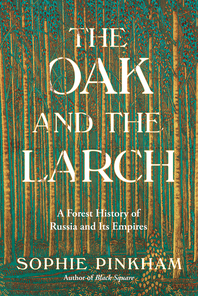
The Oak and the Larch
A Forest History of Russia and Its Empires
20 January 2026
Territory Rights — Worldwide including Canada, Singapore and Malaysia, but excluding the British Commonwealth.
Description
A majestic cultural and environmental history that reveals how forests have made—and resisted—Russia’s many empires.
From the Baltic to the Pacific, from the Arctic to the steppes of Central Asia, Russia’s forests account for nearly one-fifth of the world’s wooded lands. The Oak and the Larch is the first-ever English-language exploration of this vast expanse—a dazzling environmental history of Russia that offers an urgent new understanding of the nature of Russian power, and of Russia’s ideas of itself.
Inspired by the majestic oak, which towers over the country’s western heartland, and the hardy Siberian larch, an emblem of survival in the east, award-winning scholar Sophie Pinkham’s magisterial account spans centuries, revealing how forests have nourished ancient Siberian indigenous societies, defended medieval Slavic settlements from Mongol invasion, and served as both an essential natural resource and a potent cultural symbol for Russia in all its incarnations, from the days of the tsars to the Soviets to Putin’s Federation.
By examining the country from the forest’s perspective, Pinkham pushes far beyond the contemporary political environment in Russia. She draws on literature, history, and art to connect the expanse of the Russian wilderness and the nature of Russian culture, with indelible portraits of the diverse figures who have inhabited and celebrated these forests: the legendary indigenous guide Dersu Uzala, giants of literature like Tolstoy and Chekhov, political thinkers like Kropotkin and even Stalin. She confronts the forest’s role in Russia’s long history of imperial conquest, and in resistance to this conquest.
Gorgeously written and surprising at every turn, The Oak and the Larch offers a vision of Russia rarely seen in the west, as a land defined by its wilderness, shaped by its encounters with the frontier, and—much like our own—ultimately beholden to nature’s whim.
Reviews
"Elegant and informative . . . Pinkham’s ‘The Oak and the Larch’ is an inventive study of Russia’s cultural practices and its reigning mythologies." — Washington Post
"Pinkham, an academic and writer, creates an enthralling portrait of Russia through its forests, artfully combining environmental and cultural history, folklore, literature, and much more." — Maria Lipman, Foreign Affairs
"[An] expansive, often absorbing study of the role of the wilderness in the Russian imagination . . . Pinkham is at her sharpest when examining the Soviet era and its aftermath. . . There is some striking nature writing here — Pinkham’s reporting on self-taught wolf researchers who live in pristine isolation near the Russian-Finnish border is especially vivid." — Joshua Hammer, New York Times
"Fascinating . . . . [The Oak and the Larch] makes a compelling argument for the forest as a prism through which to understand Russia – including the former Soviet space – and its peoples." — Kathryn Bromwich, Guardian
"This is a clever way to retell Russian history from a new and revealing perspective." — James McConnachie, The Times
"The Oak and the Larch invites us to look at Russia not only as an empire, a conflict zone, or a geopolitical puzzle, but also as a landscape that shaped the people who shaped history. For readers who remain fascinated by Russia, while fully aware of the suffering its state has inflicted, Pinkham’s book offers something rare: perspective, nuance, and a quiet kind of wonder." — Jonas Vaicikonis, Washington Independent Review of Books
"Perceptive, wide-ranging, and gracefully written, The Oak and the Larch is a momentous chronicle of Russia’s vast and vital woodlands and their agency in a human history that touches us all. The lessons we follow from this sylvan past—and this book—will determine our future on Earth." — Jack E. Davis, Pulitzer Prize-winning author of The Gulf
"The Oak and the Larch gives us a new way to think about the history and present of Eurasia—as a place defined by how people have lived with trees. . . . Sophie Pinkham shows the vast range of relationships it’s possible to have with the forest, from conquest to coexistence, offering urgent lessons for a time when living with our environments is so key." — Bathsheba Demuth, author of Floating Coast
"The forest has been friend and enemy, sanctuary and prison, zone of industry and realm of the spirit. Sophie Pinkham gives us not just a new way to see Russian history but an unexpected source of inspiration for renewing our own relationship with the natural world." — Ben Tarnoff, author of Internet for the People
"For Sophie Pinkham, Russia’s forests contain everything: animals and spirits, legends and fairytales, seeds of the world’s greatest novels, whole histories of political repression and revolution, and hope for a radically post-national future. The Oak and the Larch is a towering achievement, a work of remarkable synthesis and sensitive storytelling." — Merve Emre, contributing writer for The New Yorker and author of The Personality Brokers
"Sophie Pinkham’s book, drawing on a range of disciplines, from history to folklore, ecology to economics, and written with sophistication and wit, presents Russia and its empires in a dramatically new light. A revelation that entertains as much as it enlightens." — Douglas Smith, author of Former People
"In this epic but sprightly history, journalist and critic Pinkham explores the central role forests have played in the Russian cultural imagination. . . Among the many salient through lines she identifies . . .Pinkham draws eloquently on Russia’s writers and political thinkers . . . Airy and elegant yet covering much ground, it’s a fascinating wander through Russia’s woods." — Publishers Weekly (starred review)
Awards
Shortlisted — Pushkin House Book Prize, 2026
