




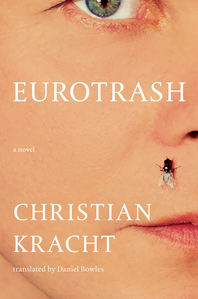

Description
By turns disturbing, disorienting, hilarious, and poignant, and brilliantly rendered in English by prize-winning translator Daniel Bowles, Eurotrash tells an intensely personal and unsparingly critical story of contemporary culture; a story that shows us a writer at the pinnacle of his powers of insight and observation.
Reviews
"Eurotrash is quite simply a joy to read. Daniel Bowles has produced a glitteringly metaphorical translation, rich with delights: the mother’s skin has “the texture of dry silk”; the taillights of cars during a downpour are “mirrored in the puddles, orange-red and episodic, like little wet flames.” The narrator’s mother is an unforgettable literary creation, and scenes in which he serves as a nurse for her potentially embarrassing health needs are quite genuinely moving. Psychogarbage or not, Eurotrash is a brilliant and unsettling reckoning with history and memory, and with the ambiguities inherent in the art of writing fiction in the first place." — Morten Hoi Jensen, Washington Post
"Slim, hilarious, and devastating . . . Eurotrash, which comes to us in a lithe translation by Daniel Bowles, is an absurdist, tragicomic double act. Its sensibility is steeped in Continental elegance, plunder, blood and ennui . . . Eurotrash is a cautionary tale of corrupted families in corrupted systems that churn out corrupted individuals. It is also an unremitting hoot." — Toby Lichtig, Wall Street Journal
"Hilariously unsettling . . . Beneath the acrid humour and the furious invective there develops a genuine tenderness in the relationship between Christian and his mother. . . . Such a fearless prose-stylist deserves an equally fearless translator, and in Daniel Bowles, Kracht has once again found a perfect partner." — Ángel Gurría-Quintana, Financial Times
"Eurotrash is a knowing book, with excursions into German history and allusions to Shakespeare, myth, and pop culture. Part of its charm is the voice of its narrator, a self-aware snob-insider who is anatomising the avarice and insecurity of the privileged class he was born into... spikily contemptuous of the opulence it depicts and narrated by a more literate and self-aware version of Kendall Roy. The translator Daniel Bowles does a great job here and throughout, rendering the prose into a vivid English that feels both idiomatic and inventive... Short but hefty, Eurotrash is a book about ageing that’s steeped in a guilty knowingness about privilege, wealth and the 20th century. There’s something bracing about the narrator’s pained awareness that if there’s such a thing as the wrong side of history, he and his family are firmly on it." — Marcel Theroux, The Guardian
"Eurotrash is a raucous story with a thrumming undercurrent about legacy, personal responsibility, and family ties that’ll keep you turning pages well after your bedtime." — Liz Doupnik, Marie Claire
"A frolicking rumination on waning parent-child relationships and the struggles of approaching the final chapter of life." — The Times [UK]
"Some literary reputations take shape over decades; others, like Christian Kracht’s arrive fully formed. Kracht has become a much surer writer in the last thirty years. He has more ideas, more voices, a more varied emotional palate at his disposal. The addition of Kracht’s mother in particular, as an object of observation, interlocutor, and emotional core opens up Eurotrash. The book’s most jolting and darkly amusing chapters are the early ones in which Christian recounts his family’s entanglements with National Socialism. Kracht’s latest, Eurotrash, out now with Liveright, ties together all of these dangling threads of his literary output—the louche, self-absorbed jet-setter, the historical fabulist, the remixer of cultural and national identity." — Michael Lipkin, Baffler
"Reading Christian Kracht’s Eurotrash is like holding up a mirror to another mirror and admiring the infinite reflections… In this book that lies between a novel and a fictionalized history, the author presents an uncanny level of self-awareness… Though the made-up Kracht and his mother could not be described as good people, you can’t help but sympathize with them in the end." — Zuzanna Lachendro, New Statesman
"Eurotrash is funny and cruel and full of moments that will catch you so by surprise with pathos and irony that your breath will catch in your throat. It’s a novel nimbly built upon a series of delicate balances... This novel is an incredible reckoning." — Chris Lee, Boswell Book Company
"This is a provocative take on elite European culture: a large still-life of dust-lined objects, each with its own toxic history, its uses and representations; an invisible gravity measurable in language." — Alexander Leissle, The Times Literary Supplement (UK)
"Kracht (The Dead), winner of the Swiss Book Prize, turns the concept of the road trip on its head... The road trip provides the means for mother and son to relive their past, learn about each other, and exhibit affection, irritation, and anger with each other and with the world around them. The novel moves back and forth through time with hallucinogenic intensity. In this work of autofiction, Kracht deftly reveals the narrator’s conflict and guilt." — Jacqueline Snider, Library Journal
"Incendiary . . . A playful tale of reconciliation that never becomes saccharine, this is one readers won’t want to miss." — Publishers Weekly, starred review
"Whether he’s fictionalizing history in order to question the validity of history or fictionalizing himself in order to question the validity of self, it is by now apparent to me and to his many readers that Christian Kracht is the great German-language writer of his generation." — Joshua Cohen, Pulitzer Prize–winning author of The Netanyahus
"There’s a refreshing bright moral clarity to Christian Kracht’s Eurotrash. Less than eighty years ago, grandpa was enslaving people to death. So when you learn that your share is 14 million Swiss Francs, how do you make it right?" — Nell Zink, author of Doxology and The Wallcreeper
"Christian Kracht began his storied career as Germanic literature’s late-capitalist enfant terrible, then somehow—stealthily, almost magically—transformed himself into its conscience. Eurotrash is Thomas Bernhard’s Extinction with a sense of humor." — John Wray, author of Gone to the Wolves and Lowboy
"Christian Kracht is a master of beautifully constructed sentences, the elegance of which conceals dread. His novels are about Germany, about ghosts, about war and delusion and every conceivable horror, but they are also full of melancholy comedy, and they all contain a hidden secret that you never quite get to the bottom of." — Daniel Kehlmann, author of Tyll and You Should Have Left
Awards
Longlisted — International Booker Prize, 2025
Standalone Ebook
9781324094579

COMING SOON