




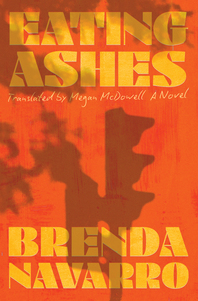

Description
SOON TO BE A MOTION PICTURE DIRECTED BY DIEGO LUNA
An arrestingly beautiful, award-winning novel about separation, migration, and love left behind.
Now, his ashes in hand, she must return to Mexico. Plagued by memories, she recounts their young lives leading up to tragedy in blistering detail: the acute loneliness that accompanied their emigration; the siblings’ first separation, when she left for Barcelona to make her own way in the world; her activism against labor abuses, which is threatened by her tumultuous relationship with an entitled lover; and the final, heavyhearted confrontation with her brother. Caught between rage and heartbreak over the loss of Diego, she pieces together a story of alienation, but also of surprising courage and hope.
Masterfully translated by National Book Award winner Megan McDowell, and shot through with flashes of dark humor, Eating Ashes boldly confronts both the intimate and systemic struggles faced by migrants striving to build a life worth living. Already an international sensation across Europe, this novel cements Brenda Navarro as a breathtakingly unique and vital voice in literature.
Reviews
"A rising star of Latin American literature has written a novel that refuses to reduce grief to a scheduled tour through ennobling sorrows. Brenda Navarro dispenses with fairy tales about acceptance and considers mourning as a kind of backbreaking labor, like childcare or housecleaning. Unlike peddlers of platitudes, Navarro is a major talent who knows that the most important stages of grief are ambivalence and guilt." — Nicolás Medina Mora, New York Times
"Eating Ashes hit me in the most profound way. With her trademark powerful prose, Brenda Navarro brilliantly tells a haunting, tragic story of siblings far from home, and the result is devastating. A moving take on migration, racism, and inequality that is as pertinent as ever." — Diego Luna, actor and director
"Extraordinary." — Garth Greenwell
"Avoiding melodrama, Navarro writes in a matter-of-fact tone, using short, clipped sentences suited to the wretchedness of her subject. This is a book that treats its characters and incidents seriously and—at its best—ruthlessly." — New Yorker, "Briefly Noted"
"Navarro’s exploration of grief is deft and raw.... The prose, in translation by Megan McDowell, is visceral and exploratory, the narrator exhibiting an almost childlike fascination with her subject." — Emily Goulding, Times Literary Supplement
"Empathetic, almost humanist intent ...Brenda Navarro’s second novel, Ceniza en la boca, has all of the above elements lurking in the background. However, the book considers them through the eyes of those who have grown so desperate to escape the cycle of violence that they leave their home and, at least temporarily, their family in search of a happier, safer, more prosperous life. McDowell’s translation is characteristically excellent throughout." — Cory Oldweiler, Los Angeles Review of Books
"Sliding back and forth between the past and the present, Eating Ashes paints a gritty, emotional, and forceful vision of a family traumatized by disconnection . . . Navarro has a gift for convincing dialogue . . . a powerful novel about a family that fares—unsuccessfully—in survival mode." — Brooks Geiken, Arts Fuse
"Raw, ingenious, and addictive." — El País
"[A] masterpiece." — El Mundo
"This lovingly written story centers on an unnamed narrator traveling from Spain to her home in Mexico to deliver her brother’s ashes. Introspective and reflective, Eating Ashes is a candid and stark exploration into loss, grief and familial relationships." — Karla J. Strand, Ms. Magazine
"Brenda Navarro, one of Mexico’s most brilliant new writers, Eating Ashes, transfigures trauma into a web of meaning, taking a nonlinear path throug the unnamed narrator’s memories as she tries to make sense of her brother Diego’s suicide. g. Just as the narrator eats her brother’s ashes, so too does Navarro eat the words of Vampire Weekend, translating them into Spanish, only for them to be translated back into English by Megan McDowell in a rich intertextual game of telephone. This wise, deeply felt work delves into profound grief and emerges with meaning." — Eric A. Ponce, BookPage
"Navarro confronts the intimate and systemic struggles that migrants face and asks what it means to live a life worth living in this novel about alienation and courage." — Electric Literature
"In this commentary on memory and migration, Navarro also plumbs the depths of grief with visceral intensity." — Frieze
"In Navarro’s capable hands, Eating Ashes is far from didactic. Instead, the book reads like a stunned stream of consciousness, flitting back and forth between the past and the present. These are not chapters, per se; they’re dazed meditations... Eating Ashes breaks our hearts, but doesn’t put them back together again. It does, however, carefully cradle the pieces." — Laura Zornosa, 1 Minute Critic
"While Navarro is broadly interested in themes of immigration and the colonial legacy, the novel is firmly rooted in the specific, palpable lives of her characters, which she renders with nuance and honesty.... A sensitive portrayal of sibling love, grief, and the trauma of dislocation." — Kirkus Reviews, starred review
"Navarro crafts a realistic depiction of memory’s free association, as her narrator bounces like a pinball from one idea to the next. This sorrowful novel teems with life." — Publishers Weekly
"McDowell's translation is lyrical and powerful... [Eating Ashes] is a vivid, visceral, and impactful novel." — Sara Martinez, Booklist
"A brilliant new voice, eviscerating and propulsive." — Miriam Toews, author of Women Talking
"One of the best-kept secrets of Mexican literature." — Fernanda Melchor, author of the International Booker Prize–shortlisted Hurricane Season
"An author who knows that behind all affection lies hidden danger." — Yuri Herrera, author of Signs Preceding the End of the World
"A tender story about how our families and places of origin, shape and warp and rattle us yet still resist comprehension. Brenda Navarro writes with wide open eyes and a relentless desire to understand." — Catherine Lacey, author of Biography of X
Awards
Shortlisted — Kirkus Prize, 2026
Also By: Megan McDowell 
The Mysterious Disappearance of the Marquise of Loria
Paperback, 2025
Sensual and semi-fantastic, this erotic novel by José Donoso—for the first time in English—is a thrilling and unsettling exploration of identity via sexual desire
Ten
Paperback, 2024
An astonishing collection of short stories by one of the most daring prose experimentalists of the 20th century
The Obscene Bird of Night: unabridged, centennial edition
Paperback, 2024
Newly revised and updated by Megan McDowell, and with a new introduction by Alejandro Zambra: at last, the unabridged, centennial edition of Donoso’s terrifying masterpiece sees the light of day
Yesterday
Paperback, 2022
For the first time in English, a mind-bending, surreal masterpiece by “the forerunner of them all” (Pablo Neruda)
Yesterday
E Book, 2022
For the first time in English, a mind-bending, surreal masterpiece by “the forerunner of them all” (Pablo Neruda)
