




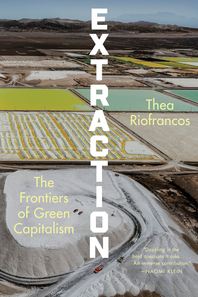
Extraction
The Frontiers of Green Capitalism
24 November 2026
Territory Rights — Worldwide including Canada, Singapore and Malaysia, but excluding the British Commonwealth.
Description
“Dazzling in the bold questions it asks.… An immense contribution.” —Naomi Klein
An in-depth investigation into the growing industry of green technologies and the environmental, social, and political consequences of the mining it requires.
Lithium, a crucial input in the batteries powering electric vehicles, has the potential to save the world from climate change. But even green solutions come at a cost. Mining lithium is environmentally destructive. We therefore confront a dilemma: Is it possible to save the world by harming it in the process?
Having spent over a decade researching mining and oil sectors in Latin America, Thea Riofrancos is a leading voice on resource extraction. In Extraction, she draws on groundbreaking fieldwork on the global race for lithium. Taking readers from the breathtaking salt flats of Chile’s Atacama Desert, to Nevada’s glorious Silver Peak Range, to the rolling hills of the Barroso Region of Portugal, she reveals the social and environmental costs of “critical minerals.” In Washington, DC, and Brussels, she tracks the escalating geopolitics of green technology supply chains. And she takes stock of new policy paradigms in the Global South, where governments seek to leverage mineral assets to jumpstart green development. In the process, Riofrancos uncovers surprising links across history, from colonial conquest to the 1970s energy crisis, to our still uncertain green future.
While unregulated mining could inflict irreversible harm, Riofrancos offers optimistic proposals to transform the governance of mining while also reducing the sheer volume of global extraction. A rigorous and hopeful call to action, Extraction shares how we can harmonize climate goals with social justice—and set the planet on a course to ecological flourishing.
Reviews
"Indispensable, deeply researched, compellingly argued, and beautifully written…pointing the way to what a truly just sustainable global economy could look like." — Greg Grandin, Pulitzer Prize-winning author of The End of the Myth
"Among the best, and most beautifully written, climate-and-energy books I’ve read not only this year but any year." — Wen Stephenson, Nation
"A vivid and bracing tour of the ruptures and conflicts to come." — David Wallace-Wells, author of The Uninhabitable Earth
"[Thea Riofrancos] takes seriously the costs of the green transition but argues that the paradox is, in fact, the result of false choices and a limited vision.… [S]uggests that a different, fairer, and greener world—one that demands less energy altogether—is possible." — Scott W. Stern, Atlantic
"Ultimately, the extraction dilemma for lithium and other elements as methods for meeting human ‘wants’ versus ‘needs’ will likely endure. Books like Extraction help us to remain vigilant about the costs of such choices." — Saleem H. Ali, Science
"An illuminating examination of the emerging renewable economy." — Sophia Kalantzakos, Nature
"Thea Riofrancos, while impressively conversant with the economics of resource extraction, endeavors to think about what an environmentally tolerable future for the mining sector…might look like without resorting to the tired ‘externality pricing’ nostrums of the economic cognoscenti." — Brett Christophers, Times Literary Supplement
"Lithium and other critical minerals are essential to the green energy transition. But mining them comes at a cost.… [Riofrancos] argues that despite this, there are ways to transform mining governance and create a truly just economy." — Foreign Policy
"[Riofrancos] argues quite persuasively that energy production is a portal connecting the past and possible future of global capitalism." — Daniel Steinmetz-Jenkins, Nation
"A thoughtful, engaging, and politically useful exploration of how to imagine and fight for a different green transition.… Riofrancos’s book could not be timelier in its depiction of the frontiers of green capitalism." — Ashley Dawson, Los Angeles Review of Books
"Engagingly written and meticulously researched, its combination of history, politics, and economics promises to challenge easy answers on climate, no matter where on the political spectrum they come from. A must-read." — Olúfémi O. Táíwò, author of Reconsidering Reparations: Why Climate Justice and Constructive Politics Are Needed in the Wake of Slavery and Colonialism
"In clear and page-turning prose, Thea Riofrancos brings to life the rush for lithium and what it means for the many lands and peoples caught up in this historic transformation." — J. R. McNeill, author of The Great Acceleration: An Environmental History of the Anthropocene Since 1945
"An unflinching journey into the gritty details of the burgeoning green economy—rigorous and fun to read. You’ll never look at an electric car the same way." — Malcolm Harris, author of What's Left: Three Paths Through the Planetary Crisis
"With a steadfast commitment to justice in our environmental century, Thea Riofrancos’s incisive work delivers a powerful message: Stop whitewashing the green economy." — Jack E. Davis, Pulitzer Prize-winning author of The Gulf: The Making of An American Sea
"An urgent wake-up call, and a hopeful, beautifully written book that is necessary reading for all in search of paths to a more just and truly sustainable future." — Isabella M. Weber, author of How China Escaped Shock Therapy: The Market Reform Debate
"Honest, clear-eyed, challenging, this essential book is an antidote to naivety and ignorance but not to hope." — Adam Tooze, author of Crashed: How a Decade of Financial Crises Changed the World
"A powerful call to arms for anyone serious about climate justice." — Grace Blakeley, author of Vulture Capitalism: Corporate Crimes, Backdoor Bailouts, and the Death of Freedom
"Deeply researched and incisively argued.… A vital read." — Amir Lebdioui, author of Survival of the Greenest: Economic Transformation in a Climate-Conscious World
"A remarkable book that never misses the global story in the local, or the local in the global.… Deeply researched, beautifully written, the book provides an accessible road map through difficult concepts and phenomena." — Kathryn Hochstetler, author of Political Economies of Energy Transition: Wind and Solar Power in Brazil and South Africa
"A lucid and coruscating view into the world that is, and the world to come." — Laleh Khalili, author of Extractive Capitalism: How Commodities and Cronyism Drive the Global Economy
"Thoughtful, rigorous, engaged, and unafraid to look at the international demands made of us here in the United States. It’s a model of political logic and solidarity." — Raj Patel, author of Stuffed and Starved: The Hidden Battle for the World Food System
"A well-researched look at global needs and wants, in conflict with local rights." — Kirkus Reviews
Ebook
9781324036777

Powered by VitalSource
£18.03
Coming Soon