




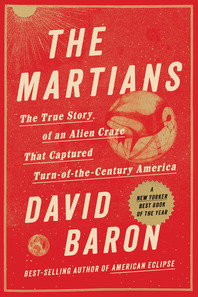

Description
“There is Life on the Planet Mars” — The New York Times, 9 December, 1906
The The New York Times headline was no joke. In the early 1900s, many believed intelligent life had been discovered on Mars. Reconstructed through newly discovered clippings, letters and photographs, The Martians begins in the 1890s with a Harvard scion who was so certain of his Mars discovery that he (almost) convinced a generation of astronomers that grainy photographs of the red planet revealed meltwater and an intricate canal system, declaring “there can be no doubt that living beings inhabit our neighbouring world” (The New York Times).
A frenzied international controversy soon arose. Inventor Nikola Tesla announced he had received Martian radio signals, biologists debated whether Martians were winged or gilled and a new genre called science fiction arose. While Lowell’s claims were debunked, his influence sparked a compulsive interest in Mars and life in outer space that continues to this day.
Reviews
"The world is gaga for Mars. Its richest man, Elon Musk, is actively scheming to colonize the red planet over the next decade… Under the long, dark shadow cast by this ambition, the science journalist David Baron has produced a short, twinkling book about the origins of Mars mania… You can consider Baron a sort of sun, shedding light… In Baron’s true tale, reputations rise and fall, and ego distorts like a smudged lens." — Alexandra Jacobs, The New York Times Book Review
"Mars, our barren neighbor, has served as an empty canvas for our expansionist imaginations since long before Elon Musk arrived on the scene. Baron chronicles the lasting influence of the Mars mania that gripped America during the early 1900s, how it captured the imaginations of Nikola Tesla and Alexander Graham Bell, generated speculative news headlines, fueled astronomical ambitions and left an indelible imprint on our culture." — The New York Times Book Review
"[The Martians] shows how fantastical beliefs gained purchase in a pre-Facebook age… Still, if Baron deftly illustrates the historical roots of collective phantasms, his book is ultimately most interesting for what it says about the timelessness of our shared fascination with the stars, and Mars in particular" — Jon Allsop, The New Yorker
"Baron’s vivid narrative reads as part history, part social study, and part literary drama, making complex scientific dynamics accessible without sacrificing depth… The Martians does more than examine this episode in astronomical history; it also illuminates the very human processes by which science is often made, contested, and believed." — Dov Greenbaum, Science Magazine
"[A] convivial and rigorously researched history of the first Martian craze… The Martians is fundamentally a portrait of the man who turned Mars into the night sky’s red Rorschach blot." — Nathaniel Rich, The New York Review of Books
Also By: David Baron 
American Eclipse: A Nation's Epic Race to Catch the Shadow of the Moon and Win the Glory of the World
Paperback, 2024
Richly illustrated and meticulously researched,American Eclipseultimately depicts a young nation that looked to the skies to reveal its towering ambition and expose its latent genius
American Eclipse: A Nation's Epic Race to Catch the Shadow of the Moon and Win the Glory of the World
Hardback, 2017
This nineteenth-century celestial drama will enthral readers as a coast-to-coast total solar eclipse plunges America into darkness.
American Eclipse: A Nation's Epic Race to Catch the Shadow of the Moon and Win the Glory of the World
E Book, 2017
Richly illustrated and meticulously researched,American Eclipseultimately depicts a young nation that looked to the skies to reveal its towering ambition and expose its latent genius
The Beast in the Garden: A Modern Parable of Man and Nature
E Book, 2010
The true tale of an edenic Rocky Mountain town and what transpired when a predatory species returned to its ancestral home.
The Beast in the Garden: The True Story of a Predator's Deadly Return to Suburban America
Paperback, 2005
"Reads like a crime novel . . . each chapter ends on a cliff-hanging note."—Seattle Times
