




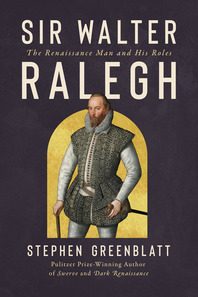
Sir Walter Ralegh
The Renaissance Man and His Roles
2 October 2026
Territory Rights — Worldwide.
Description
Stephen Greenblatt’s early masterwork on Sir Walter Ralegh’s life as art
Exposing the tensions and contradictions of Renaissance England, Stephen Greenblatt presents Sir Walter Ralegh as a symbol of his age–focusing on his lifelong attempt to fashion his own identity as a work of art. At moments of crisis, Ralegh was always acting out a role. The interplay between life and art animated both his actions and his writing. Greenblatt approaches Ralegh’s execution, poetry and paradoxical attempt to write his History of the World to explore the Renaissance man and his many roles.
Greenblatt follows Ralegh’s turbulent career from his 1592 disgrace to his 1603 conviction for treason. Blending historical, literary and psychological insight, he brings vital dimension to a figure long shrouded in myth–one of the most compelling characters in his own recent Dark Renaissance.
Stephen Greenblatt’s Dark Renaissance (9780393882278) was praised as:
- “This evocative book offers a portrait of Elizabeth England: a time of paranoia, surveillance and violence, but also blistering creativity.” – Economist, “Best Books of the Year”
- “Dazzling.… [D]oes indeed at times read like something out of La Carré.” – Jonathan Bate, Observer
- “[A] terrific read… Dark Renaissance is a thrilling, twisty tale that brilliantly captures the horror and the possibilities of that lost, crepuscular world.” – Jonathan Healey, The New York Times
- “Since his critical debut…[Stephen] Greenblatt has understood and practiced criticism as a higher form of storytelling.” – Emma Smith, Times Literary Supplement
- “In its sweep, pace and scholarship, this book vividly contextualises Marlowe’s brilliance as a dissident thinker and a wildly innovative writer.” – Will Tosh, Literary Review
- “An evocative new biography.” – The Economist
- “An unforgettable literary biographical tour de force.” – Robert McCrum, Independent
- “Stephen Greenblatt’s attempt to reconstruct the playwright’s story is brilliant.” – John Mullan, New Statesman
Also By: Stephen Greenblatt 
Dark Renaissance: The Dangerous Times and Fatal Genius of Shakespeare's Greatest Rival
Paperback, 2026
Dark Renaissance: The Dangerous Times and Fatal Genius of Shakespeare's Greatest Rival
Hardback, 2025
The Norton Anthology of English Literature: The Middle Ages
Eleventh Edition, Volume A, Paperback, 2024
The Norton Anthology of English Literature: The Sixteenth and Early Seventeenth Century
Eleventh Edition, Volume B, Paperback, 2024
The Norton Anthology of English Literature: The Restoration and the Eighteenth Century
Eleventh Edition, Volume C, Paperback, 2024
